

Why Roofing Estimates in Omaha Can Differ by $5,000+ (How to Compare Roofing Quotes With Confidence)
If you've ever gotten more than one roofing estimate, you may have been surprised by how different the quotes were. Everyone says you’re supposed to get at least three separate bids, but doing so can quickly become overwhelming and confusing when estimates can vary by so much.
One company quotes you $9,500, while another quotes $12,200, while a third quotes $14,500. Same house. Same roof. While this situation is extremely common, it leaves many homeowners wondering: “Am I being ripped off, or is someone cutting corners?”
The answer is: Probably at least one of those things is true, if not partially both.
There’s no denying that there are real reasons roofing quotes vary by thousands of dollars, and some of them have nothing to do with your roof. Once you understand what's actually driving these numbers, you'll be in a much better position to pick the right contractor — not just the cheapest one, and not just the most expensive one either.
Here's what's actually going on.
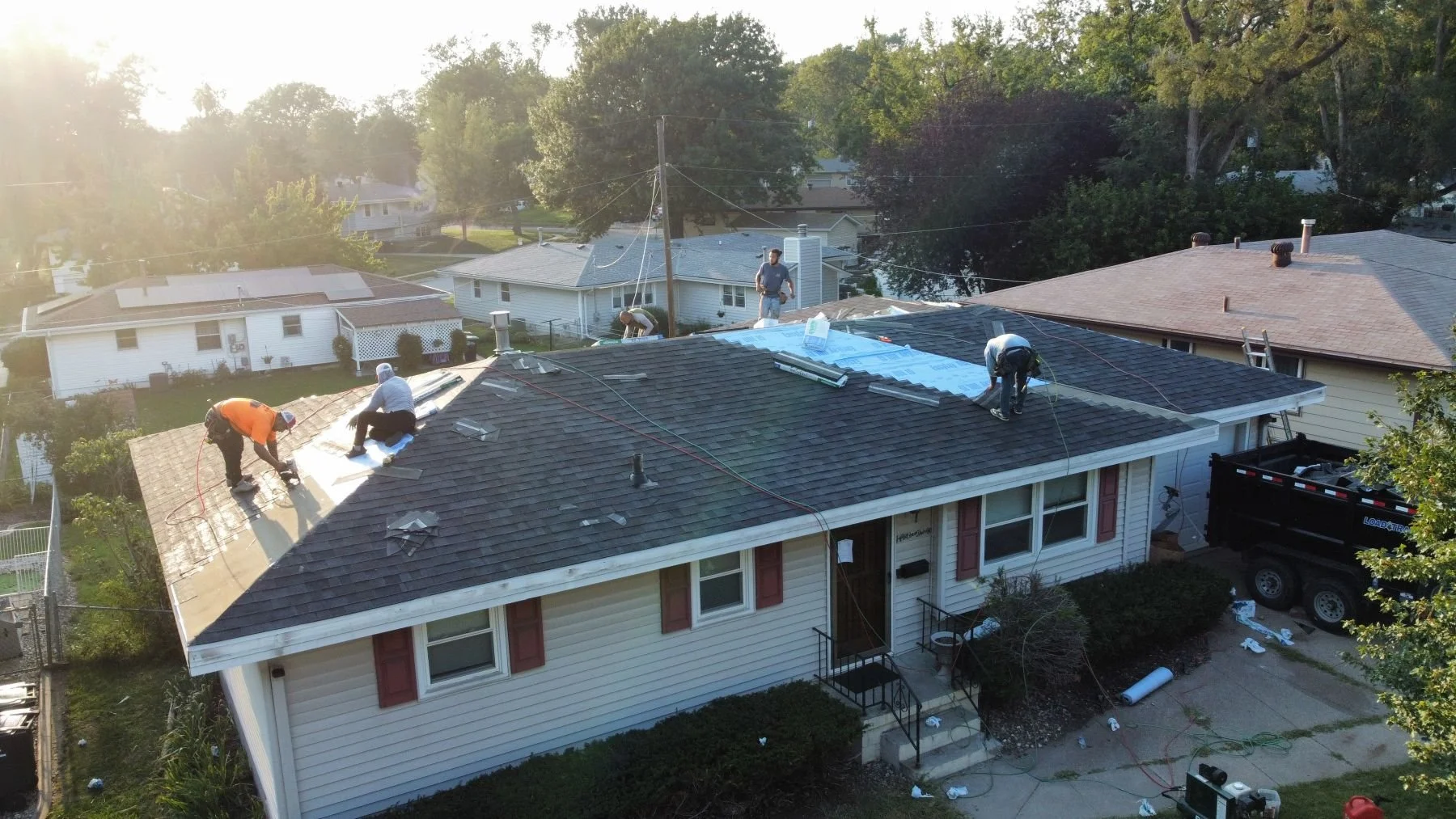
Roofing crew replacing a residential roof in Omaha Nebraska
Part 1: Business Overhead — What You're Paying for That Has Nothing to Do With Your Roof
Large Companies Carry Large Costs
When a big roofing company sends someone to your door, that company has a lot of mouths to feed before a single shingle ever touches your roof. Office staff, project managers, fleet vehicles, warehouse / office space, utilities and operating expenses, HR, accounting, plus licensing and insurance. The bigger the operation, the higher the fixed costs. These costs must be factored into every estimate they hand you.
That doesn't make them dishonest. It just means their cost structure is different from a smaller operation, and you're paying for it whether you know it or not.
Sales Rep Commissions Are Real — and They're In Your Quote
Here's something most companies won't tell you.
If you work with a roofing sales rep, a portion of what you're paying goes directly into their pocket as commission.
In the roofing industry, commission rates typically run anywhere from 8% to 15% of the total job. On a $12,000 roof, that's $960 to $1,800 that goes to the person who handed you the estimate — not to the materials on your roof, and not to the crew installing it.
Some companies even perform a 10/50/50 commission split payout with their sales reps, meaning that after all costs are subtracted from the job (crew labor & materials) the company then subtracts 10% for overhead, and splits the remaining profit with the sales rep 50/50.
Many larger companies run entirely on a sales-rep model. They hire people specifically to knock doors, run appointments, inspections, and close deals. Those reps are often paid well, which is fine — but you should be aware that a portion of your roof cost is funding their commission.
Marketing Budgets
Some roofing companies spend heavily on TV / Radio ads, billboards, Google / Facebook Ads, door-to-door canvassing, and third-party lead generation services. Those are real expenses, which can equal thousands and even tens of thousands of dollars per month for larger operations — and like every business expense, they ultimately have to be recovered through revenue.
Something most homeowners never hear about is customer acquisition cost, which is simply what a company spends in marketing to generate one signed roofing job.
In the roofing industry, that number commonly falls somewhere in the $300–$600 range per project, and in highly competitive markets or pay-per-lead systems it can exceed $1,000 just to acquire a single customer before materials or labor are even considered.
That doesn’t mean marketing is bad — every business needs customers. But it does mean that when a company relies heavily on advertising, part of the price you’re quoted may be covering the cost of generating that lead in the first place.
If you called after seeing or clicking on an ad, there’s a good chance that advertising investment is built into the estimate somewhere. It has to be for the business model to work.
Big Doesn’t Equal Bad: The Silver Lining
It’s easy to assume that a higher estimate from a larger roofing company automatically means you’re overpaying. That isn’t always true.
Large companies often operate at a scale smaller contractors simply can’t match. Some complete hundreds of roofing projects per year, while smaller owner-operator businesses may complete between 50–100 annually. That volume can create real efficiencies.
Bigger companies may receive bulk pricing on materials, maintain dedicated crews that work together every day, and have systems in place that allow projects to move quickly from scheduling to completion. In some cases, those efficiencies can actually make their pricing surprisingly competitive despite higher overhead and marketing costs.
They may also offer advantages that matter to certain homeowners — larger support staff, faster scheduling during peak storm seasons, or the perceived security of a bigger organization behind the warranty.
The key takeaway isn’t that large companies are better or worse. It’s that they operate under a different business model. Understanding that model helps explain why estimates vary — and why price alone doesn’t tell the full story.
What matters most isn’t company size, but clarity. You should understand exactly what you’re getting, how the work will be performed, and who is ultimately responsible for the quality of the installation.
These business factors explain part of the price gap — but the more important differences often come from how the roof itself is installed.
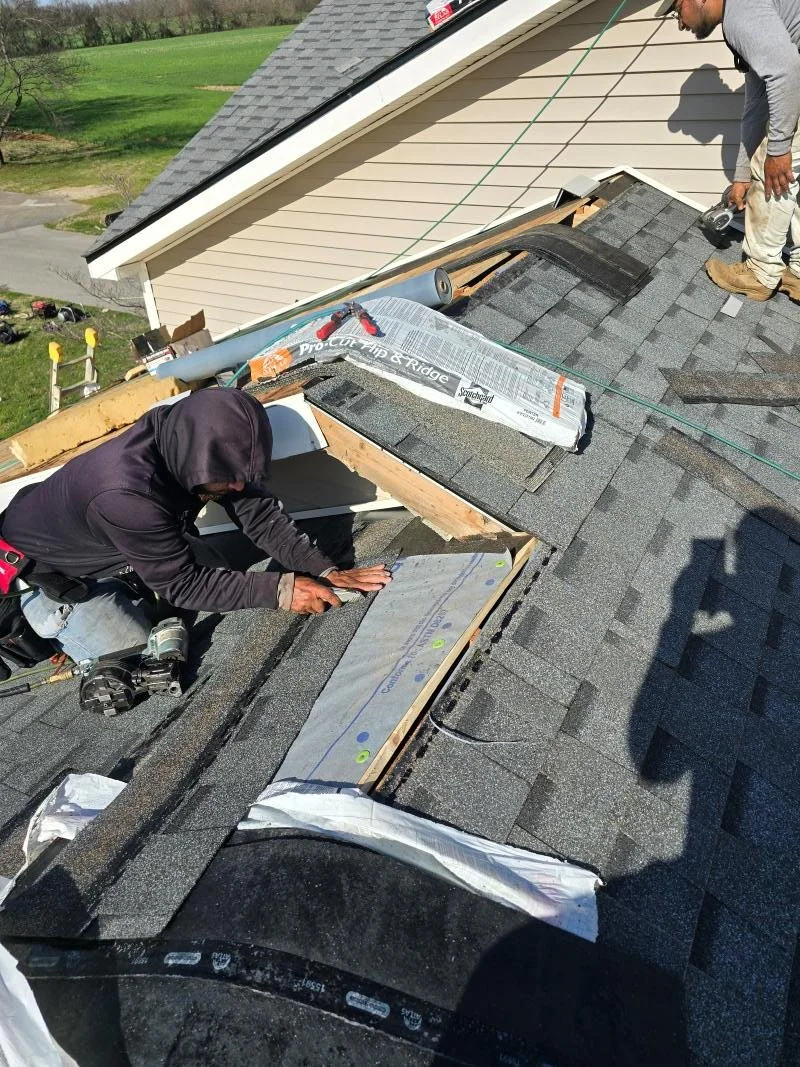
Installing synthetic underlayment with ice and water shield along with step flashing and other roofing components during a new roof replacement — details like these often separate high-quality installations from low-bid jobs.
Part 2: Quality of Work — Where the Real Differences Show Up
Overhead and commissions explain a lot of the price variation between companies. But some of the gap comes from something more important: what they're actually doing to your roof.
This is the part that matters most, because a cheaper estimate isn't always a bad deal — but it can be if corners are getting cut on installation.
Flashing: The Most Overlooked Line Item
Flashing is the metal that seals the transitions on your roof — where the roof meets a wall, where it wraps around a chimney, where it terminates at a dormer. It's not glamorous, but it's where nearly every roof leak originates.
Step flashing is the L-shaped metal installed piece by piece alongside each shingle course where your roof meets a wall. Doing it right means weaving it in with the shingles as they go, one piece at a time. It's slow. It takes longer. Some crews skip it, overlap-flash instead, or just run a single continuous piece of flashing and call it a day. That's cheaper to install, and it will leak eventually.
Chimney flashing is even more involved. A proper chimney reflash means removing the old counter flashing from the mortar joints, cutting new reglets into the brick, installing new step flashing and base flashing, and sealing everything with proper caulk — not just a bead of roofing tar over the top of old flashing. The tar method is faster, cheaper, and will fail within a few years. It's extremely common on low-bid jobs.
Drip edge and gutter apron flashing protect the edges of the roof where water exits into the gutters and off the sides. These metal pieces direct water away from the fascia and decking and help prevent moisture from wicking back underneath shingles. Some estimates reuse existing edge metal or install minimal coverage to save time and material cost, even though replacing it during a reroof provides better long-term protection.
Pipe boot flashing seals around plumbing vents that penetrate the roof. These boots contain rubber or synthetic collars that degrade over time from UV exposure. Reusing old pipe boots is a common shortcut on lower bids, but failed pipe boots are one of the most frequent sources of small roof leaks a few years after installation.
If an estimate looks suspiciously low and doesn't specify flashing replacement, ask directly: are you replacing all flashings, or are you going over what's there? The answer will tell you a lot.
Underlayment
Underlayment sits directly on the roof decking before shingles are installed. Standard felt paper (15 lb.) is the bare minimum. Synthetic felt underlayment is heavier, more tear-resistant, and provides better protection during installation and over the life of the roof.
Some low-bid contractors use 15 lb. felt. Some use synthetic but cheap brands. Some use quality synthetic but only in partial coverage. The cost difference per square isn't dramatic — but over 20-30 squares, it adds up, and it's an easy way to quietly reduce job cost without it being obvious to you.
Ice & Water Protection (Especially Important in Nebraska)
Another detail that often varies between estimates is ice and water shield.
Ice and water shield is a self-adhering waterproof membrane installed along roof edges, valleys, and other vulnerable areas. Unlike standard underlayment, it seals around nail penetrations and helps prevent water from backing up underneath shingles.
This matters in Nebraska, where freeze–thaw cycles can create ice dams that force water under roofing materials. Standard underlayment provides protection, but ice and water shield is designed for these higher-risk conditions.
Ice and water shield is also typically the second most expensive material component of a roof — behind shingles — when measured per square foot. Because of that, some contractors limit coverage to reduce costs, while others install more comprehensive protection.
When comparing estimates, don’t just ask whether ice and water shield is included — ask where it will be installed and how much coverage is planned.
Ventilation: One of the Most Important — and Most Ignored — Parts of a Roof
Ventilation is one of the most critical parts of a roofing system, yet it is one of the least discussed when estimates are compared.
A roof needs to do two things: keep water out and allow air to move through the attic. Proper ventilation pulls fresh air in through soffit vents and exhausts heat and moisture through ridge or roof vents. Without balanced airflow, heat becomes trapped in summer, accelerating shingle aging from underneath. In winter, warm attic air can create condensation that contributes to ice dams and moisture damage.
Two roofs can look identical from the street, but the one with properly balanced ventilation will typically last longer.
Ventilation upgrades require additional materials and labor, so they do not always appear in lower-priced estimates. Some contractors replace shingles without evaluating airflow at all. When reviewing estimates, ask whether ventilation is being assessed, not just whether shingles are being replaced.
Decking Replacement
Most homeowners never see this part.
Decking issues are impossible to fully evaluate until tear-off begins, which is why transparent contractors explain this possibility ahead of time.
When we tear off a roof, we find out what's underneath. Some homes have decking that's in great shape. Others — especially homes from the 1970s and 80s that are common in Bellevue, Papillion, La Vista, and parts of Omaha proper — have areas of soft, delaminated, or rotted decking that needs to come out.
A legitimate contractor prices this honestly. Either they include a decking replacement allowance in the estimate, or they price it per sheet as a potential add-on and disclose that up front.
A contractor cutting corners either doesn't disclose this at all (surprise costs at the end) or worse — nails shingles over bad decking because it's faster and they figure you won't know. You won't, until water follows a nail hole through soft wood straight into your attic.
Shingle Quality Tiers (Major Price Factor)
The shingle you and your contractor choose to install is often the most important and expensive part of any roof replacement.
Not all shingles are created equal. Even within a single brand like GAF, Atlas, Owens Corning, or CertainTeed, you’ll find entry-level, mid-grade, and premium options. A Timberline HDZ and a Timberline CS may carry the same brand name, but they’re built differently and come with different warranties.
Some contractors use the entry-level product and don't tell you. Some let you choose. Make sure any estimate specifies the exact shingle line, not just the brand.
Nail Patterns and Fastener Placement
This is invisible to you once the job is done, which is exactly why some crews cut corners on it. Improper nailing — wrong placement, incorrect nail length, or too few fasteners — is one of the leading causes of wind damage claims, especially in Nebraska where high winds are common.
Most shingle manufacturers require a minimum of four nails per shingle, while some enhanced wind warranties require six nails per shingle. That may not sound significant, but it represents 50% more fasteners across the entire roof.
On an average Omaha home, that difference can mean thousands of additional nails installed across the roof, increasing labor, time, material usage, and installation precision.
A nail driven too high or a shingle fastened below manufacturer specifications may not cause immediate problems, but it often shows up during the next major windstorm — long after the crew is gone.
Good crews follow manufacturer specifications carefully. Fast crews sometimes don’t.
What to Look for When Comparing Roofing Estimates
When you're comparing roof estimates, don’t focus only on the final number. Evaluate the company itself and ask each contractor questions like:
Are you replacing all metal flashings, or going over existing materials?
What underlayment product are you using, and what’s the specification?
How is decking replacement handled — included as an allowance or priced as needed?
What exact shingle line is being installed, and what warranty does it carry?
Will permits be pulled with the appropriate municipality?
A contractor who gets annoyed by these questions is telling you something. A contractor who answers them clearly and confidently is usually worth taking seriously.
The lowest estimate and the highest estimate are often both wrong. The lowest may be cutting corners on materials or labor. The highest may simply reflect a different business model with larger overhead and marketing costs.
The right estimate is the one you fully understand — where the scope is clear, installation methods are explained, and you know exactly who is responsible for the work being done on your home.
Still Have Questions About a Roofing Estimate?
If you'd like a second opinion on a quote you’ve received before making a decision, feel free to reach out to me directly and I’ll be happy to help — even if you just want clarification on what another contractor included or left out. I believe homeowners should understand their options before making a decision.
